

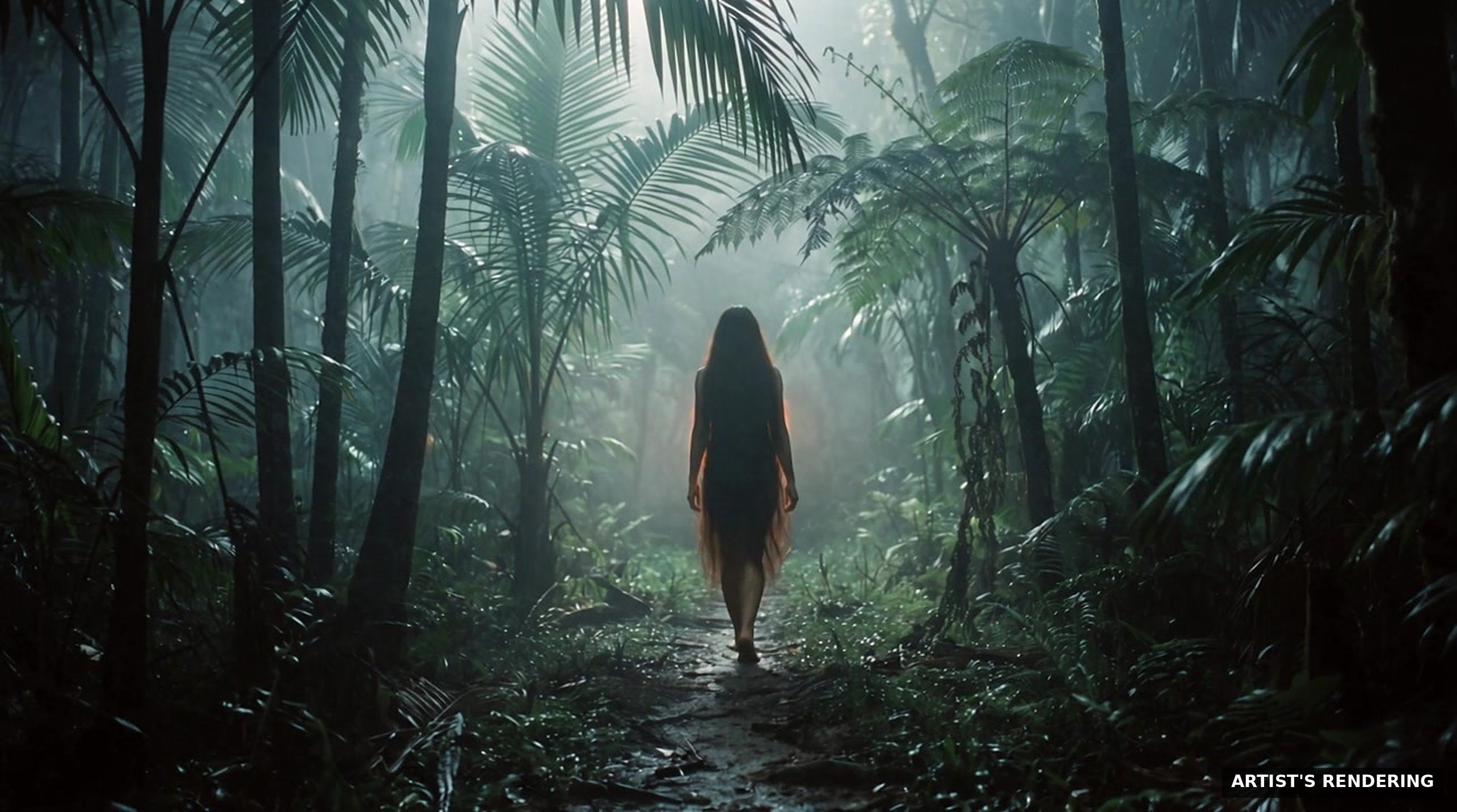
I broke our own rule this week. The Colorado X-Files is supposed to be about Colorado. This one isn't.
On a recent trip to the Dominican Republic, I did what I always do when I travel. I went looking for the stories people don't tell the tourists: the ghost stories, the things in the woods, the stuff your grandmother warned you about. Down there, one name kept coming up.
La Ciguapa. You say it see-GWAH-pah.
The full episode is up on YouTube:
This is the longer version, with the sources, and with the parts I couldn't fit on camera.
First, some respect
Before anything else, I want to be clear about what this is. The Ciguapa isn't a monster I flew down there to make fun of. She's living folklore. People grew up with her. Their parents and grandparents told her story at night, usually to keep kids out of the woods after dark. I tried to treat her that way, and I'll keep doing that here.
What people told me
Here's the version you'll hear most often. She's a small, beautiful woman who lives wild in the mountain forests. Her hair is so long it covers her whole body. And her feet are on backward, heels in front and toes behind, so her tracks point the opposite way from where she's actually going. Anyone who tries to follow her gets led deeper into the forest. In the darker tellings, she lures men in, and they don't come back.
Getting someone to tell it on camera took a while. Plenty of people knew the name. A couple I talked to on the beach didn't know the story at all, so I ended up reading it to them, which is not how I pictured that going. The woman who braided my hair said her mother had told her about the Ciguapa when she was little.
Then my friend Danny introduced me to a tour guide named Rafael, and we sat down under a beach pavilion on Saona Island.
Rafael didn't oversell it. He said there isn't much to tell, that there's no proof she exists, and that today most people see her as a myth. Then he put it in terms I could understand: she's "practically like Bigfoot in America."
He described her the way his grandparents did. A young woman with long hair all over, living in the wild, coming into the villages for the men and taking them off into the jungle or a cave. What she wanted them for, nobody ever knew. You usually only ever saw one. Rafael is 46, and he said the old people would warn you, if you went into the jungle by yourself, to be careful of the Ciguapa.
That's the part that stuck with me. The legend isn't just a story about a creature. It's an instruction: don't go out there alone.
If you're ever on Saona and want to hear it from Rafael yourself, he runs tours. He asked me to share his WhatsApp: +1 829-708-3176.
The real mystery is where she came from
Here's where the journalist in me got hooked, and it isn't the question of whether she's real. It's the question of where she started.
Most people will tell you she's ancient, that she goes back to the Taíno, the people who lived on Hispaniola long before Columbus showed up. Maybe she does. But when the Spanish arrived, their chroniclers wrote down a great deal about Taíno beliefs, and the Ciguapa isn't in any of it. She isn't in the colonial records, and she isn't in the cave art.
The first time anyone wrote her down, as far as we know, was 1866. That year a Dominican journalist, poet and playwright named Francisco Javier Angulo Guridi published a story called La Ciguapa. (One Dominican national library document dates it to 1876, but most sources say 1866, including the scholarship I lean on below.)
His Ciguapa is a little different from the one Rafael described. She's beautiful, about three feet tall, with lustrous hair down to her calves. She can't speak, only howl, and she leaps through the trees like a bird. In his story she's jealous of human love; she kills with fright and then dies of sorrow herself. Some scholars say the backward feet came later, in retellings, and that writer Juan Bosch's 1935 essay helped lock them in. I haven't read Guridi's original text myself yet, so treat that last part as what the secondary sources say, not something I've confirmed.
There are three main theories about her origin, and I don't think anyone has settled it.
Theory one: she's a 19th-century creation. Sociologist Ginetta Candelario, writing in the journal Small Axe in 2016, argues the Ciguapa is not a pre-colonial Taíno legend. Guridi spent about 30 years living in Cuba, and "ciguapa" was already a word there: it was the common name for a big, dark night owl, the Stygian owl, described in a French natural history of Cuba around 1838–40. (I used a public-domain plate from that book in the episode; the caption under the owl literally reads "SIGUAPA.") There was also a town called La Ciguapa in eastern Cuba. Guridi was part of a movement trying to build a Dominican identity of its own, and a homegrown legend fits that project. So one reading is that a writer helped invent a national legend right when the country was figuring out who it was.
Theory two: she's very old, and she came from South America. Dominican historian Bernardo Vega pushes back hard. In a 2021 column, he writes about finding the same idea in northeast Brazil: a forest spirit called the Curupira, whose feet are turned backward so hunters follow the tracks the wrong way. The Curupira was written down by a Jesuit priest, José de Anchieta, in a letter from 1560. The Taíno's ancestors, Arawak-speaking peoples, came up from that same part of South America through the island chain. Vega thinks they carried the idea with them. He also concedes the Spanish chroniclers never mention her, which is exactly the gap theory one points to.
Theory three: she's a memory of real people. This is the one that gets me. Starting in the early 1500s, people escaping slavery, Taíno and African, fled into the mountains of the island and built hidden communities. Some writers think the Ciguapa is a memory of them: people living wild in the mountains, hard to find, impossible to track. Historian Carlos Larrazábal Blanco made that case in 1975. Writer Manuel Mora Serrano went further and suggested the backward feet come from people walking backward to throw off the slave hunters.
I want to be straight with you about that last detail. It's a theory. I haven't found documented proof that people actually walked backward to escape. But if it's even partly true, the scariest thing in the forest was just somebody trying to stay free.
The tracks
That brings me back to the feet, which Rafael kept coming back to. You never know where she's going, or where she's coming from.
If you watch the show, you know my co-host, Bigfoot Kenny Collins, lives and dies by tracks: stride, depth, where the weight lands. Here's a legend built to beat a tracker. Kenny, I'd love to see you try to cast one of these. To be clear, backward feet aren't part of mainstream Bigfoot lore; Rafael's comparison is about how the two legends live in people's heads, not a claim they're related.
She's even made it into science. In 2012, researchers Juan Daza and Aaron Bauer named a tiny gecko preserved in Dominican amber Sphaerodactylus ciguapa, for where it was found, its dark color and its twisted little feet.
And she's alive right now in a very different way. A new ballet, La Ciguapa, choreographed by Alina Abreu to mark her 40-year career, premieres November 13–15 at the Teatro Nacional Eduardo Brito in Santo Domingo. Abreu has said that turning those backward feet into dance was one of the biggest challenges of the piece.
So who is she?
An ancient spirit carried up from the Amazon? A story a writer helped create in 1866? Or a memory of real people who ran into those mountains and never came back down?
I don't know, and I'm not sure anyone does. What I do know is that a man under a beach pavilion told me his grandparents warned him about her. For a lot of folks down there, that's where she lives.
You decide. And if you grew up with the Ciguapa, or with a story like her where you're from, I really want to hear it.
A note on what you're seeing
The night-forest scenes, the backward footprints in the mud and the moonlit mountains in the episode are AI-generated and labeled ARTIST'S RENDERING on screen. They're recreations of the legend, not footage of anything real. The owl plate is a real public-domain illustration, and the route map is drawn from public-domain map data.
Keep the lights on
If you want more of this, subscribe to the Colorado Switchblade. It's free, and it's where the deeper reporting lives.
Over on YouTube, like, subscribe and share The Colorado X-Files. For a small independent show, that's the thing that helps most.
With the holidays coming up, the Colorado X-Files shop has hoodies (I'm wearing our Blue Mist of Estes Park design in the episode), tees, mugs, hats and slate coasters I engrave myself here in Estes Park. If you've got someone who loves these stories out of the Colorado mountains, you might find them the perfect gift, and every purchase funds the next investigation.
Got a strange story, or something your grandmother warned you about? The tip line is coloradoxfiles@gmail.com.
Sources
Ginetta E. B. Candelario, "La ciguapa y el ciguapeo: Dominican Myth, Metaphor, and Method," Small Axe 20, no. 3 (2016)
Bernardo Vega, "Orígenes del mito de la Ciguapa," Acento (Jan. 12, 2021)
Manuel Mora Serrano, "¿La Ciguapa podría ser la imagen de Marca País?," Acento
Ciguapa (Wikipedia), for its summary of Rodríguez (2003), Larrazábal Blanco (1975) and Bosch (1935)
Curupira (Wikipedia), on José de Anchieta's 1560 letter
Daza & Bauer, "A New Amber-Embedded Sphaerodactyl Gecko from Hispaniola," Breviora 529 (2012)
Édouard Traviès, "Otus siguapa", Histoire physique, politique et naturelle de l'île de Cuba (public domain)
Hoy: "La Ciguapa": la leyenda dominicana cobra vida en el TN
My interview with Rafael on Saona Island, and conversations on the beach
