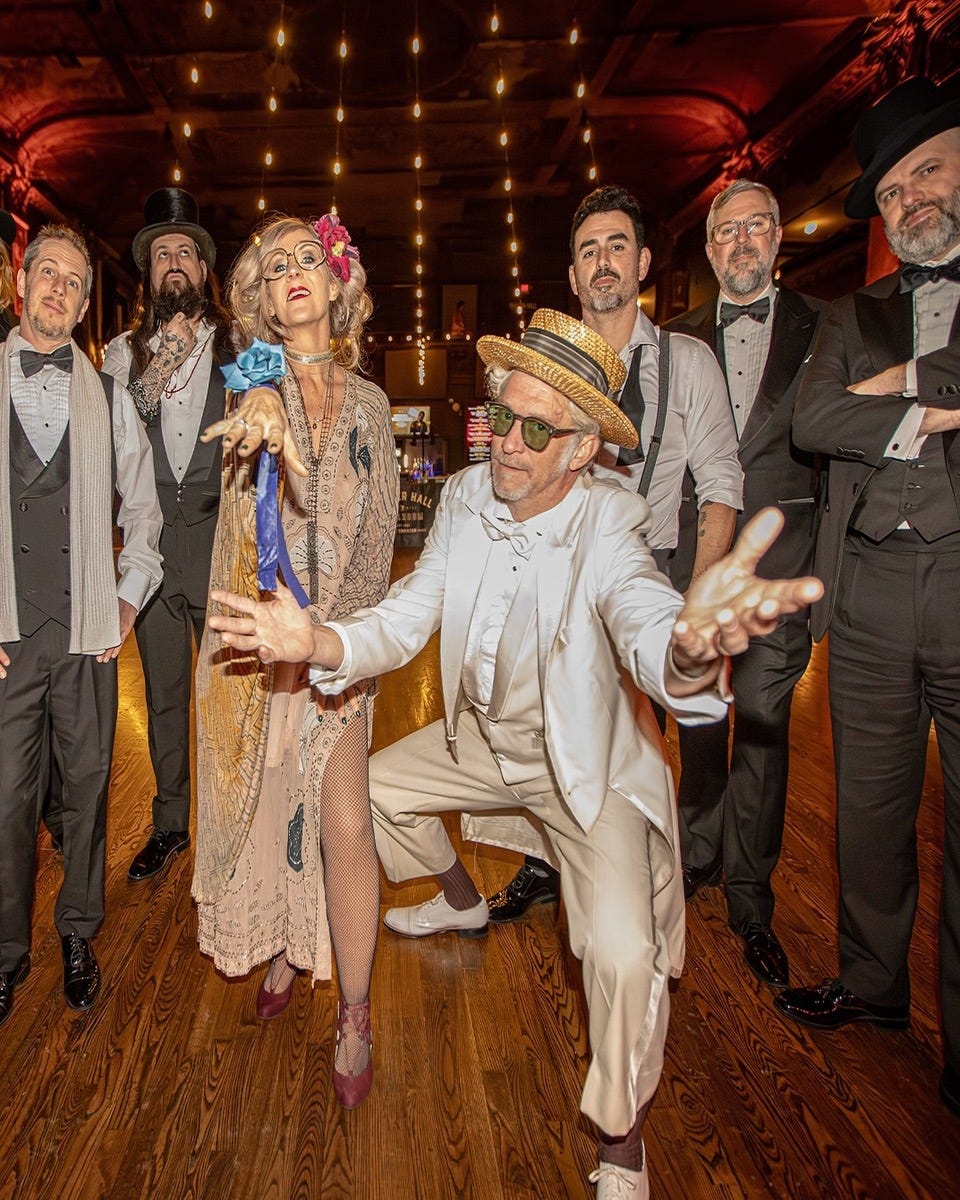
Swing, Spirits, and Happy Accidents:
Jimbo Mathus and the Strange Afterlife of the Squirrel Nut Zippers
One of the strange gifts of spending your life around artists is that you eventually learn to recognize the moment when you’ve stumbled across a kindred creative mind.
It usually happens quickly. A certain way someone talks about the work. The influences they mention. The strange paths they took to get there.
Not the polished career arc version of creativity.
The other version.
The version where a kid spends hours hunched over a record player, dropping the needle back again and again, trying to figure out what the chords are doing… or where someone disappears into dusty libraries chasing the ghosts of Edgar Allan Poe and Damon Runyon.
That was the feeling I had talking with Jimbo Mathus, founder and guiding creative force behind the Squirrel Nut Zippers.
Within minutes of our conversation drifting into old jazz recordings, gothic literature, and forgotten corners of American culture, I realized we were speaking the same strange creative language.
Mathus grew up in rural Mississippi surrounded by musicians. I grew up hearing stories about the New York art scene from my grandparents, who were part of the abstract expressionist movement that reshaped American painting in the mid-20th century.
Artists chasing ghosts. Mine lived in the books high above my grandparents’ living room, climbing a rolling staircase to pull down dusty tomes of literature—many overlapping with the same authors and artists Jimbo would also discover in the libraries of Chapel Hill.
Different mediums.
Same current.
In Mathus’s case, those ghosts happened to sound like ragtime, vaudeville, and early jazz drifting out of 78-rpm records.
Thirty years after the release of the Squirrel Nut Zippers’ platinum-selling album Hot, Mathus and the modern incarnation of the band are celebrating the record’s unlikely legacy with an “In the Afterlife” weekend at the Stanley Hotel in Estes Park on March 20–21, 2026.
For a band whose most famous song cheerfully catalogs the torments of eternal damnation, the famously haunted Stanley feels like the perfect venue.
“We like playing historic places,” Mathus told me. “We’ve never done anything quite like this, but we do have that dark humor and that creepy aesthetic.”
The Stanley Hotel, of course, famously inspired Stephen King’s The Shining, which makes it an oddly fitting place for a band whose songs often hide darker themes beneath upbeat rhythms.
“There’s a lot of times dark messages under there,” Mathus said.
Learning the Music the Hard Way
The strange part of the Squirrel Nut Zippers story is that the band wasn’t made up of seasoned jazz historians.
In fact, quite the opposite.
“I can’t think of one single person in the group that had any background in jazz or hot music for more than a couple of years at that point,” Mathus told me. “We were just learning as we went.”
That admission might surprise fans who associate the band with the swing revival of the 1990s.
But the truth is that the Zippers weren’t trying to lead any movement.
They were simply chasing sounds they had discovered in old recordings.
Mathus describes spending long hours with the Smithsonian jazz collection, dropping the needle back again and again to decipher chord progressions and arrangements.
It was a kind of musical archaeology.
Stop the record.
Listen again.
Move needle back.
Try to figure out what those musicians were doing.
“We were trying to emulate things we heard on records that we liked,” he said.
Not surprisingly, they got things wrong.
And those mistakes became part of the band’s sound.
“If you don’t know the rules,” Mathus said, “sometimes you find some cool stuff.”
From Mississippi to Chapel Hill
Mathus’s fascination with older American music goes back to childhood.
“My relatives and friends were all musicians in northeast Mississippi,” he said. “We had a real hillbilly tradition playing in the family.”
He started playing music young—around six years old—and grew up absorbing folk traditions, bluegrass, and the deep well of Mississippi blues.
But when he moved to Chapel Hill in the early 1990s, a much larger creative world suddenly opened up.
For the first time, Mathus had access to university libraries packed with art, literature, and music archives.
“I just started devouring everything,” he said. “The theater, the art, the music collections.”
It was exactly the kind of intellectual explosion that can shape a young artist’s direction.
The Squirrel Nut Zippers were born in the middle of that discovery.
Mathus began combining everything he was absorbing—old jazz recordings, gothic literature, early American songwriting traditions—into music that felt both nostalgic and completely new.
Happy Accidents in the Studio
When the band recorded Hot in 1996, they weren’t chasing radio success.
They were chasing a sound.
The recording process leaned heavily on early jazz techniques—live takes, minimal studio polish, and musicians clustered around microphones.
But the album’s most famous track, “Hell,” nearly disappeared entirely.
“The multitrack of that song was accidentally erased by the engineer one morning,” Mathus recalled.
All that remained was a rough mono mix the band had been using as a reference.
“So that’s what we used,” he said.
The accidental recording became the final version.
Sometimes the universe—or the engineer—makes the decision for you.
The Strangest Hit of the 1990s
Imagine walking into a record label office in 1996 and trying to pitch a song called “Hell.”
It’s upbeat. It swings. It rides a calypso rhythm. And lyrically, it’s a cheerful catalog of eternal damnation.
Somehow, it worked.
“I never expected it would catch fire with MTV,” Mathus said.
But the mid-1990s were a strange moment in American music.
Swing revival bands were suddenly appearing across the country. Retro aesthetics were finding new audiences. Radio was still loose enough to occasionally let something unusual break through.
“Radio was still pretty open to different sounds,” Mathus said. “They kind of let us in.”
Once the momentum began, it carried the band into surreal territory.
They found themselves performing at the Olympics, appearing on national television, and even playing a presidential inauguration.
“It’s crazy when that happens,” Mathus said of the sudden success.
A Band Reborn
Like many bands that experience sudden success, the Squirrel Nut Zippers eventually fractured.
But around the time of the band’s twentieth anniversary, Mathus began reconsidering the music he had created decades earlier.
At first he resisted the idea of revisiting it.
Then curiosity got the better of him.
“I realized I knew so many incredible players in New Orleans,” he said.
What would those songs sound like now, performed by seasoned jazz musicians steeped in the traditions that originally inspired them?
The answer became the modern version of the band—a nine-piece ensemble filled with New Orleans players who bring fresh energy to the material.
“I wondered what it would sound like with a nine-piece band,” Mathus said.
Audiences responded immediately.
The band found itself returning to historic theaters, festivals, and venues across the country.
“It just started taking off,” Mathus said.
Why the Music Still Works
Three decades after Hot first appeared, the music still resonates with audiences.
For Mathus, the explanation is simple.
“It’s timeless,” he said. “There’s a reason why that music evolved and why it came to be.”
Blues, jazz, gospel, folk—these traditions sit at the foundation of American culture.
“I think it’s in our DNA as Americans,” he said.
Which brings us back to the Stanley Hotel.
On March 20–21, the Squirrel Nut Zippers will perform Hot in its entirety as part of the “In the Afterlife” celebration, along with additional concerts, jazz brunch performances, and screenings of classic Max Fleischer cartoons.
Mathus has never played the Stanley before.
I warned him about the altitude.
If the hotel’s ghosts wander into the ballroom during the show, I asked what song he might play for them.
Mathus thought about it for a moment.
“The Ghost of Stephen Foster,” he said with a laugh.
And if there’s a better place to celebrate the strange afterlife of American music than a haunted hotel high in the Rocky Mountains, I haven’t found it yet.
The Squirrel Nut Zippers perform their “In the Afterlife” weekend at the Stanley Hotel in Estes Park on March 20–21, 2026.
Tickets and event details:
https://www.stanleyhotel.com/calendar/squirrel-nut-zippers
Available in Hardcover, Kindle editions, and on Audible!


