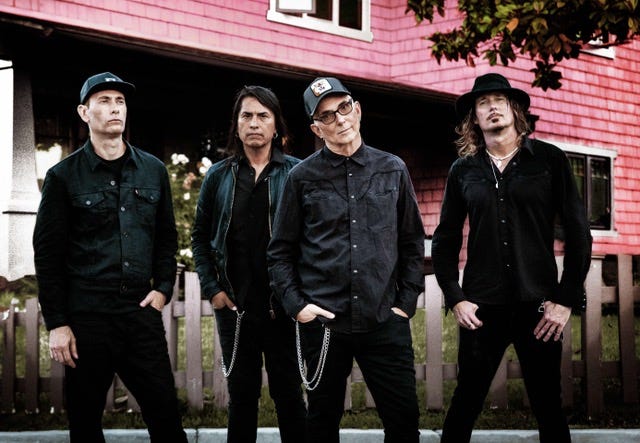
Everclear’s Art Alexakis on Survival, Songwriting, and Why You Keep Moving
A conversation with Everclear’s founder on songwriting, survival, and what keeps you moving when stopping isn’t an option.
By Jason Van Tatenhove
Colorado Switchblade
I’ve always thought Everclear songs read like short stories that just happen to come with distortion pedals.
You don’t so much listen to them as inhabit them. They’re populated by fathers who disappear, kids who grow up too fast, people clinging to love or sobriety or momentum because the alternative is something darker. For a lot of us who came of age in the ’90s, those songs didn’t just soundtrack our lives. They sat with us in the mess.
So when I got Art Alexakis on the phone ahead of Everclear’s upcoming shows at the Stanley Hotel, I didn’t want to talk about nostalgia. I wanted to talk about survival. About what it takes to keep moving when stopping would be easier, and far more dangerous.
Alexakis is sixty-three now. He’s been sober for decades. He’s raised a family. He’s watched friends disappear. And in 2019, he publicly revealed that he has multiple sclerosis, a disease he believes he’d likely been living with for years before the diagnosis. None of this, he makes clear, has slowed him down in the way people expect.
“I don’t know how long I’m going to be able to work,” he told me plainly. “So yeah, a lot of the reason we’re working so much these days is because I have to.”
That sentence lands heavier than it looks.
This isn’t rock-star hustle-culture theater, or romanticized suffering. Alexakis isn’t chasing relevance. He’s building time. For his wife. For his eighteen-year-old daughter. For the version of himself that understands something a lot of people don’t until it’s too late: when you stop moving, you start disappearing.
He’s seen it happen.
“The people that stop moving with this disease, or even just age, they’re the ones that die early,” he said. “That’s not a trope. That’s been my experience.”
Everclear still plays sixty to seventy shows a year. Mostly fly dates now. Some bus tours. Australia and New Zealand every other year. The logistics have changed, but the commitment hasn’t. Touring, Alexakis explained, used to be endless. One tour bled into the next until the calendar lost meaning. Now it’s more controlled, more intentional, but no less demanding.
Fatigue is the real enemy. Not pain. Not even fear. Fatigue.
“I’ve learned to manage it,” he said. “Whenever I have a chance, I nap. Before a show. After soundcheck. Thirty minutes, forty minutes. You take it where you can.”
That’s the unglamorous truth of staying in the fight. Not champagne. Not myth. Just a dark room and a stolen half hour so you can still climb back onstage and mean it.
That same stripped-down honesty shows up in his creative process. Alexakis doesn’t sit down and clock in like songwriting is a shift at the mill. That’s never been how he works. He doesn’t write because it’s time to write. He writes because something starts pushing from the inside.
“I don’t sit down to write from nine to five,” he told me. “That’s never been my thing.”
What’s changed is the toolset. Where he once scribbled lyrics on cigarette packs and scraps of paper, he now records ideas into his phone. Voice memos stacked into the hundreds. Recently, he went through nearly three hundred of them and pulled out four new songs in just a couple of days while the band was together.
Those songs will form the backbone of a new Everclear album planned for later this year. And the moment we’re living through has its fingerprints on the work whether anyone wants to admit it or not.
The election. The culture. The fear in the air.
When I asked whether the current political and cultural chaos is seeping into his songwriting, he didn’t hedge.
“Absolutely,” he said. “How can it not affect you? Unless you’re a sociopath.”
He’s not talking about “writing politically” like it’s a branding strategy. He’s talking about pressure, the kind that builds until it has to come out somewhere or it turns poisonous.
“When I write about stuff like that… it’s because I have to get that out of me,” he told me. “Or it’s gonna make me fucking crazy.”
He also made something else clear: he’s never been interested in audience approval as a motive. If fewer people are listening now than in the band’s commercial peak, he’s not auditioning for their attention.
“As many people listening to me as they used to? Probably not,” he said. “I don’t care. I never did it for other people.”
That’s part of why the songs feel the way they do. A lot of Everclear’s catalog doesn’t read like rock lyrics. It reads like lived experience put under a harsh light. Which is exactly what pulled me toward the band in the first place.
So I asked him directly: a lot of these songs feel like short stories set to music. When he writes, is he consciously thinking in narrative terms, or does that structure just happen?
He surprised me by circling back to journalism. He studied it early on. He idolized writers. He name-checked Hunter S. Thompson without having to be prompted, like someone remembering a private compass.
And then he said something that explains a lot about his writing voice: he didn’t want to build a career on tearing other people down. He didn’t want to write nasty reviews. If he didn’t like something, he didn’t want to write about it. He wanted to live his own life, and tell the truth from inside it.
He also made it clear he was never going to be the “party lyrics” guy.
“I’ve never been a guy that wanted to write about getting laid or partying,” he said. He talked about bands like X, and songwriters like John Prine. The darker side of life. The real side. The part people politely avoid at dinner parties.
And then, late in the conversation, I asked the question that matters to anyone who has ever used a song like a handhold: when he writes about family, loss, survival, does he think about the listener at all?
He didn’t romanticize it. He didn’t soften it.
“Writing is one of the most selfish things you can do,” he told me. “If you do it right.”
The goal isn’t to comfort the listener. The goal is to get the voice right. The rhythm. The cadence. The truth on the page. The audience comes later, if it comes at all.
But the live show is a different animal. That’s where the exchange happens. That’s where the songs stop being private and become communal property for a couple of hours.
When I asked him about the Stanley Hotel specifically, he laughed and admitted he’d never played it before. The history excites him. Two nights in a venue built on legend. A couple of band members bringing their wives. A little human life inside the touring machine.
Denver, though, is known territory. He’s been playing Colorado since the early ’90s. He talked about the Ogden selling out. About how good those rooms feel when the crowd is with you. The relationship has endured.
And when it came time to close, he didn’t try to sell the show like a preacher or a politician. He’s not offering salvation. He’s offering rock and roll.
“I don’t give sermons,” he said. “It’s rock and roll, man.”
He wants people to walk out having had a good time. Singing along. Feeling connected. Not because the world got fixed, but because for a few hours you weren’t carrying it alone.
Everclear plays the Stanley Hotel on January 30 and 31. If these songs still feel like stories, it’s because the storyteller is still doing what storytellers do: turning pressure into something you can live with. Still moving. Still writing. Still refusing to stop.
And for those of us who grew up with those songs lodged in our ribs, that motion still matters.
~ JVT
Tickets for Everclear’s January 30 and January 31 performances at the Stanley Hotel are available at: stanleyhotel.ticketspice.com/everclearatthestanley
Now available in Hardcover, Kindle editions, and on Audible!


